Strangers Made Something Better: The Unexpected Power of Creative Chemistry Across Distance
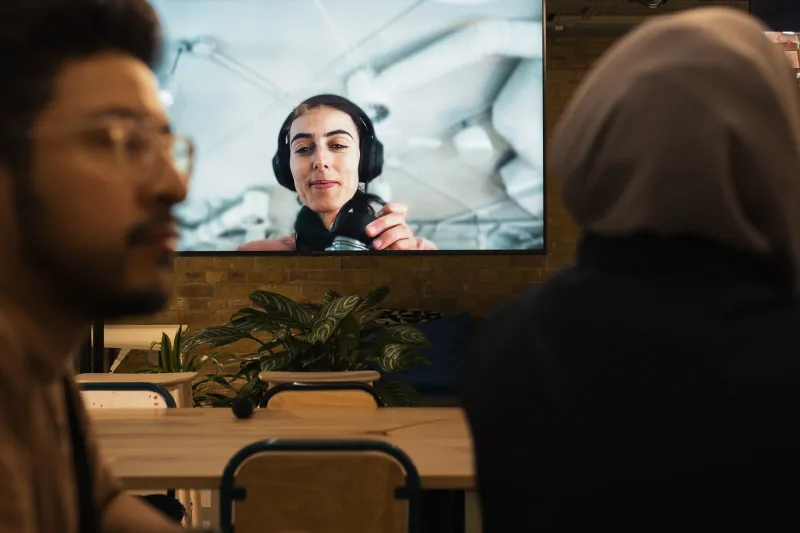
There's a filmmaker in Austin and a composer in Cleveland who have never shared a meal, never argued over coffee, never even been in the same time zone at the same time. They've also made something together that neither of them could have pulled off alone — a short film that's been accepted into three festivals and counting.
This isn't a fluke. It's a pattern.
Something genuinely interesting is happening in the creative world right now, and it doesn't fit the old model of how great work gets made. We were taught that collaboration meant proximity — the writers' room, the studio session, the production office where everyone's stuck together until something clicks. That model still works. But it's not the only model anymore, and in some cases, it's not even the best one.
Why Strangers Sometimes Outperform Longtime Collaborators
Here's the uncomfortable truth about working with people you know well: familiarity builds creative shortcuts. You start to anticipate each other. You know what the other person will love, what they'll push back on, what ideas aren't even worth floating. That intuition is valuable — but it also creates invisible walls around what's possible.
When you collaborate with someone you've never met, those walls don't exist yet. You bring your full creative vocabulary to the table without self-editing. They do the same. The result is a kind of productive friction that longtime collaborators sometimes lose.
Psychologists call this the "outsider advantage" — the phenomenon where people who aren't embedded in a particular creative culture or workflow often see solutions that insiders have stopped looking for. Remote collaboration, almost by accident, has been manufacturing outsider advantages at scale.
How Online Communities Became Unlikely Creative Incubators
Spend any real time in creative communities on Discord, Reddit, or even niche corners of Instagram, and you'll notice something: people are pitching, connecting, and shipping work constantly. A screenwriter in Chicago posts a logline looking for feedback. A cinematographer in Portland responds with a suggestion that accidentally becomes a co-writing session. Six weeks later, they've got a proof-of-concept trailer.
This isn't accidental. These platforms have essentially become the new creative residencies — minus the grant applications and the shared kitchen drama.
What makes them work is specificity. The best creative communities aren't general. They're built around a shared obsession: a particular genre, a specific aesthetic, a tool, a workflow. When you find someone in that space, you already share a creative language. The geographical distance becomes almost irrelevant because the cultural proximity is already there.
The filmmaker-composer duo mentioned earlier? They found each other in a film scoring community on Discord. One was looking for feedback on a rough cut. The other was looking for a project to score for their portfolio. The initial exchange was purely transactional. The creative relationship that followed was anything but.
What Cross-Genre Collisions Actually Produce
Some of the most interesting remote collaborations aren't just people in the same discipline working from different cities. They're people from entirely different creative backgrounds colliding in unexpected ways.
A game designer's instinct for pacing and player agency, applied to documentary structure. A fashion photographer's eye for texture and light, brought into a music video treatment. A podcast producer's ear for narrative rhythm, shaping the edit of a short film.
These cross-genre collisions are producing work that genuinely doesn't look like anything else, because it isn't coming from a single creative tradition. It's the product of two different creative educations meeting somewhere in the middle — and the middle turns out to be a pretty interesting place.
This is where remote collaboration has a structural advantage over in-person creative circles. Your local creative community, however vibrant, tends to have a dominant aesthetic. Everyone's influenced by the same local scene, the same regional festivals, the same handful of working professionals who give talks at the same venues. Remote collaboration breaks you out of that gravitational pull.
A Practical Framework for Finding Your Creative Stranger
This doesn't happen automatically. Plenty of remote creative connections go nowhere — a few enthusiastic DMs, a shared Google Doc that never gets opened, a collaboration that dissolves before it starts. Here's what separates the ones that actually produce work:
Lead with something real. Don't approach a potential collaborator with an abstract pitch. Show them actual work, even if it's rough. A rough cut, a sketch, a voice memo of an idea — something tangible gives the other person something to react to, and genuine reactions are where creative chemistry reveals itself.
Set a small, fast first project. Before you commit to anything ambitious, make something tiny together. A two-minute short. A single track. A one-page treatment. Small projects reveal whether your working styles are actually compatible without either party investing too much.
Pay attention to what surprises you. The most valuable thing a creative stranger brings is the unexpected — the reference you'd never have pulled, the structural choice that feels wrong at first and then completely right. If you're not getting surprised, you're probably not getting the full benefit of the collaboration.
Build in asynchronous breathing room. One underrated advantage of remote collaboration is that you're not forced to respond in real time. Use that. Send a draft, let it sit with the other person for a few days, get a response that's been genuinely thought through rather than reflexively offered in the moment. Some of the best creative notes come from that breathing room.
The Relationship That Outlasts the Project
Here's what nobody tells you about the best remote creative collaborations: they tend to compound. The filmmaker and composer make one short film. Then they make another. Then one of them introduces the other to someone in their network, and suddenly there's a three-person creative unit that wouldn't exist without that original Discord message.
Remote collaboration, at its best, isn't just a workaround for geographical inconvenience. It's a way of building a creative network that's genuinely diverse — in background, in discipline, in aesthetic — in ways that a purely local creative circle rarely is.
The strangers who make something great together don't stay strangers for long. And the work they make in that early window, before familiarity sets in and the creative shortcuts start forming, is often the most surprising thing either of them has ever been part of.
If you haven't gone looking for your creative stranger yet, the communities are out there. So is the work you haven't made yet.