The Tools That Are Supposed to Help You Are the Ones Draining You Dry
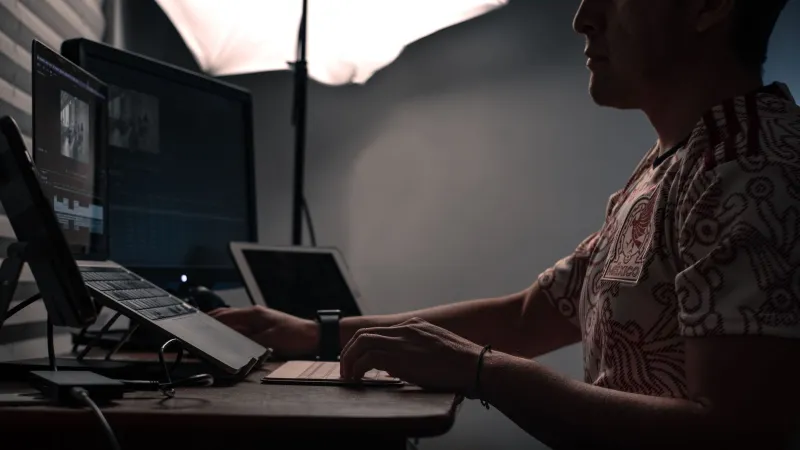
At some point in the last decade, 'democratizing creativity' became the tagline for an entire industry of software, platforms, and production tools. And on the surface, it worked. You can now color grade on a laptop that costs less than a single day of rental gear from the early 2000s. You can distribute a film globally from your kitchen table. You can score a project using AI-assisted tools that would have required a full studio just fifteen years ago.
So why does it feel like creative work has never been harder to actually sit down and do?
The Paradox of the Empowered Creator
Here's the uncomfortable truth: the same tools that lowered the barrier to entry also raised the cognitive cost of doing the work. Every new capability comes bundled with new decisions. Every new platform comes with a new interface to learn, a new notification stream to manage, a new set of metrics to interpret and stress about.
Psychologists have a name for what happens when you face too many choices with too many variables — decision fatigue. It's the reason you can spend forty-five minutes choosing a font and then feel genuinely exhausted before you've written a single word. It's the reason a filmmaker can spend an entire Saturday afternoon researching export codecs and end the day feeling like they worked hard while producing absolutely nothing.
Your tools are not neutral. They have interfaces designed by product teams whose success metrics are engagement and retention — not your creative output. Those are not the same thing.
What an Attention Thief Actually Looks Like
Not all tool-related friction is obvious. The most damaging attention thieves tend to feel productive. Here's what to watch for:
The platform that requires constant tending. Social distribution is a legitimate part of modern creative work. But there's a meaningful difference between a strategic posting schedule and compulsively checking engagement numbers every ninety minutes. If a platform has trained you to refresh it the way you check a text from someone you're nervous about, it's consuming creative bandwidth that belongs to your work.
The software with infinite options and no defaults. Some tools are built for professionals who need granular control over every parameter. If you're not that professional — or if that level of control isn't what your project actually requires — that same software becomes a maze you wander through instead of a road you drive on. Complexity that doesn't serve your specific use case is overhead, not power.
The plugin that promised to solve a problem you don't have. Creative tool marketing is remarkably good at creating desire for solutions to problems you weren't previously aware of. Before you install the next thing, ask whether you had a workflow problem before you heard about it. If the answer is no, the plugin isn't solving anything — it's just adding another variable to manage.
The collaboration platform that creates more communication than it organizes. Remote creative work has generated an entire ecosystem of project management and communication tools, many of which primarily serve to generate notifications about notifications. If your team is spending more time updating the tool than doing the work the tool is supposed to track, something's off.
Auditing Your Setup Without Burning It Down
The goal isn't to go back to pen and paper. The goal is to build a creative environment where your tools work for you rather than the other way around. Here's how to run an honest audit:
Map a real workday. For one full day, track every tool you open, every notification you respond to, and every context switch you make. Don't judge it in real time — just record it. At the end of the day, look at the list. How many of those tools touched your actual creative output? How many just consumed time between creative moments?
Separate asset multipliers from attention taxes. An asset multiplier is a tool that produces meaningfully better or faster output than you'd achieve without it. An attention tax is a tool that requires ongoing management without proportionally improving the work. Be ruthless about this distinction. Subscriptions that fall into the second category are not investments — they're overhead.
Create friction for the things that interrupt you. This sounds counterintuitive, but it works. Log out of social platforms instead of just closing the tab. Put your phone in a different room during focused work sessions. Disable non-essential notifications at the system level, not just the app level. The goal is to make interruption slightly inconvenient so that your default state is focus rather than distraction.
Default to fewer tools, not more. There's a version of creative confidence that shows up as a very simple setup — one editing timeline, one communication channel, one place where your project lives. Complexity in your toolset can masquerade as sophistication, but it often just means more surfaces for your attention to scatter across.
The Creative Energy You're Leaving on the Table
Here's what's actually at stake. Creative energy — the kind that generates genuinely original ideas, that sustains you through the hard middle of a project, that makes the work feel worth doing — is not unlimited. It depletes across a workday, and it depletes faster when your environment is fragmenting your attention.
Every time you switch contexts, every time you respond to a non-urgent notification, every time you wade through a bloated interface to find the function you actually need, you're spending a little bit of that energy on something that produces nothing. Over a week, that adds up to hours of creative capacity that went to your tools instead of your work.
The creators who sustain long careers — the ones who keep making interesting things year after year — tend to have surprisingly minimal, intentional setups. Not because they can't afford better tools, but because they figured out early that the tool isn't the creative. You are.
Protect your attention like it's the most valuable resource you have. Because it is.