No Resources, No Problem: What Creative Isolation Actually Produces
There's a romanticized version of the creative process that looks something like this: a sun-drenched studio, fast WiFi, a team of collaborators, and unlimited access to tools, references, and inspiration. It's the version that gets pinned to mood boards and featured in "day in the life" YouTube videos.
And it's also, weirdly, one of the least reliable conditions for producing genuinely original work.
The creators who consistently break new ground aren't always the ones with the most resources. More often, they're the ones who had no other choice but to invent something from scratch — because borrowing, referencing, or outsourcing simply wasn't an option.
What Happens When the Well Runs Dry
Think about what constraint actually does to a creative brain. When you have access to everything — every plugin, every reference film, every collaborator on speed dial — your first instinct is to reach for what already works. Why wouldn't you? It's efficient. It's safe. It gets the job done.
But when those options disappear, something shifts. You stop asking what's available and start asking what's possible. That's a fundamentally different question, and it tends to produce fundamentally different answers.
Robert Rodriguez famously shot El Mariachi for around $7,000, working within the constraints of what he could physically access — a small Mexican border town, a guitar case, a school bus, a turtle. Those weren't creative choices born from a mood board. They were problem-solving decisions that accidentally created a visual language people hadn't seen before. The limitations became the aesthetic.
The same logic shows up in music. Early hip-hop producers in the South Bronx didn't have recording studios or live bands. They had two turntables and a mixer. The constraint of working with pre-existing records — looping breaks, chopping samples — gave birth to an entirely new sonic architecture that reshaped global culture. Necessity didn't just mother invention here. It basically raised it, fed it, and sent it to school.
Geographic Isolation as a Creative Filter
There's a specific version of this that doesn't get talked about enough: what happens when creators are cut off not just from money, but from cultural proximity.
Filmmakers working outside major production centers — outside Los Angeles, New York, or the handful of cities where the industry clusters — often develop a visual sensibility that feels distinctly uninfluenced. They're not accidentally absorbing the current trends from industry events, film school hallways, or the ambient conversations that shape what's considered "the look" of a given moment.
That distance creates a kind of creative lag that can actually be an advantage. By the time outside influences arrive, they've often been filtered through local experience and context in ways that transform them into something new.
Filmmaker Benh Zeitlin built Beasts of the Southern Wild out of Louisiana's bayou country, working with a cast of non-professional actors and a crew that was deeply embedded in the local community. The film didn't look like anything else at Sundance that year — not because the team was trying to be different, but because their environment was different. The isolation wasn't an obstacle. It was the source.
The Overthinking Tax
Here's something that doesn't come up enough in conversations about creative process: access to resources also brings access to second-guessing.
When you have options, you have the luxury of doubt. Should the color grade go warmer or cooler? Should you hire a composer or license something? Should you bring in another editor to look at the cut? Every additional resource introduces another decision point, and decision fatigue is a real creative drain.
Creators working in isolation — with limited budgets, limited tools, and limited time — often make faster, more committed decisions simply because they have to. That decisiveness shows up in the work. There's a confidence in the choices that audiences feel even if they can't name it.
This is partly why some of the most kinetic, alive-feeling independent films have a quality that bigger-budget productions struggle to replicate. The choices weren't agonized over. They were made, committed to, and built on top of.
How to Engineer Your Own Desert
So what do you actually do with this if you're not already working in geographic or economic isolation?
You create artificial constraints. Deliberately.
Give yourself a one-location rule for your next short film. Limit your color palette on a design project to three colors. Write a script with no more than two characters. Record a track using only sounds you can make with objects in your apartment.
These aren't gimmicks. They're forcing functions — ways of cutting off the easy paths so your brain has to find the harder, more interesting ones.
Some of the most creatively productive exercises at Saharkhiz Creative have come out of exactly this kind of self-imposed restriction. When you can't reach for the obvious answer, you end up somewhere you wouldn't have found otherwise.
The Lesson the Desert Teaches
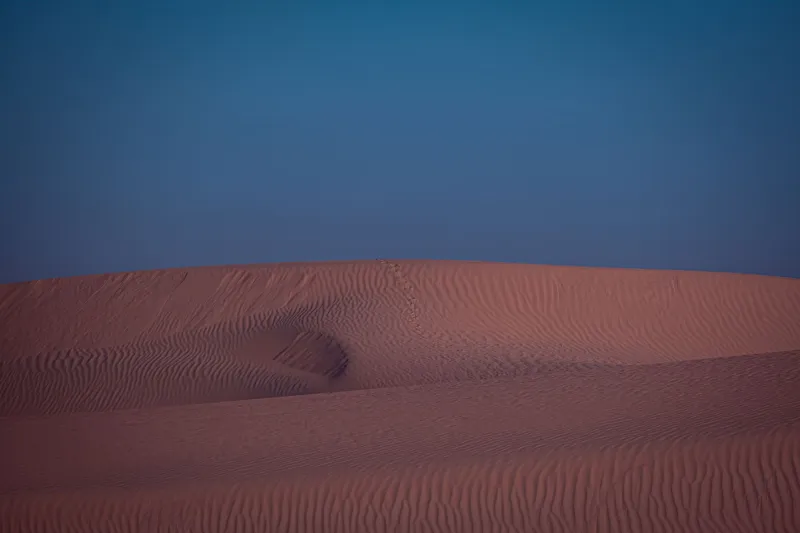
The Sahara isn't empty. It's just empty of the things you're used to relying on. Which means everything that grows there had to figure out a completely different strategy for survival — and in doing so, developed capabilities that plants in lush environments never needed to build.
Your creative work operates the same way. The periods of your career where you had the least — the least money, the least access, the least support — are probably also the periods where you made some of your most original decisions. Not in spite of the scarcity, but because of it.
The goal isn't to romanticize hardship. It's to recognize that constraint is a legitimate creative tool, and that the next time you feel like you can't make something because you don't have enough, you might actually be standing in exactly the right conditions to make something worth making.